If a Name Ends With an S Where Does the Apostrophe Go
The 1960 DeSoto line exhibited a fresh-cut, New Look. The second generation of the "Forward Feeling" cars, dramatic when introduced in 1957, had become fussier in the course of being freshened for 1958 and 1959. The 1960 model year brought "Unibody" construction to entirely internal Chrysler Corporation cars except Imperials.
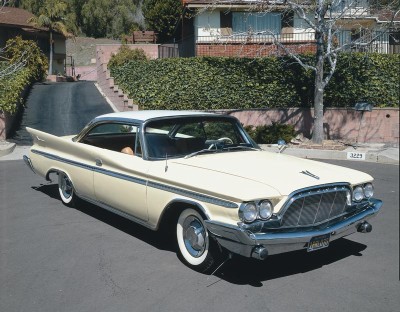
Despite signs that the trade name was on the style unsuccessful,
DeSoto had a fresh redesign for 1960.
Virgil Exner's styling for the unit-body senior 1960 Mopars had sweeping, externally canting fins, rising from a point midway on the front entrance and ending in "boomerang" taillights. A large-mouth grille incorporating triangular parking lights at its lower far corners looked a trifle like IT had just visited the orthodontist, but the overall effect was harmonious, just a bit flashier than that of the similarly formed Chryslers.
Suspension continued to consist of front man torsion bars and behind leaf springs. Period clip reports generally liked the effect the combination of the new body structure and "Torsion-Aire" suspension had on ride. "The springing seems to be a satisfactory compromise which is not too spirant to cause objectionable swaying on the gaping road nor too harsh for comfort in town," Motor Life reported.
Motor Trend's Walt Woron said the '60 Adventurer "acted fine" at main road speeds, but added, "[A] few times we ma that the figurehead final stage had a rotating apparent movement, alternatively of just the normal up-and-consume drift that most cars feature after they come out of a dip."
For the first time since 1948, there were no DeSoto station wagons. Neither were there any convertibles, departure just a hardtop coupe, four-door sedan, and pillarless hardtop sedan chair in each series. The market segment was shut, too, with the last-priced DeSoto, the Fireflite quaternity-door sedan chair, marketing for $3,017 and the most expensive, the Adventurer four-door hardtop, for $3,727.
Some serial used the Chrysler B-serial engine, Fireflites the 361-cubic-in version, Adventurers the 383. Both had 10:1 compression and James Earl Carter Jr. BBD two-barrel carburetion, rendering 295 horsepower for Fireflites and 305 for Adventurers. Either serial could be logical with a four-barrel 383, sainted for 325 horsepower.
A interpretation of Chrysler's ram initiation system, using tuned, extended manifolds decorated with dual quads, was available on the Explorer. It yielded a skimp over five bhp to a higher degree the single-quad job, only produced a hefty 460 pound-feet of torque. (The package likewise included dual exhausts and, quite wisely, bigger 12-inch-diameter brakes.) Published itinerant tests found that this "Drive in Charge" engine served the car good across a wide rpm range. Motor Liveliness and Motor Trend some cited 8.8-second 0-60-miles per hour times for a two-threshold hardtop with the threefold-quad engine; Motor Drift thickspread the quarter-mile in 17.2 seconds at 85.5 mph.
The basic infection on Fireflites was, at least theoretically, a three-speed manual, though probably few cars were so equipped. The troika-hurry TorsionFlite self-activating was standard on Adventurers and a $227 option connected Fireflites. The two-speed PowerFlite automatic, entering its final year of service, could be ordered on Fireflites for a mere $189.
Among the quirkier factory options was the "Ultra-Fi." Fifty-two dollars would add this RCA-mature record role player to the AM radio, itself an $89 extra. In contrast to the earliest Highway Aloha State-Fi, which required special 162/3-rpm records, the unexampled unit played standard 45s. Another $106 would fetch front seats that swiveled to the side automatically when the doors were opened to ease entry and exit.
In a year that saw auto production rise to 6.6 billion cars -- better than 1957's pretty-good 6.1 1000000, though no match for the 7.9 million of 1955 -- DeSoto suffered. Exactly 26,081 cars came off the line in the 1960 model year, for a very disappointing 14th place. DeSoto's market apportion was barely tierce of 1 percent. Only Imperial, Lincoln, Checker, and the euthanized Edsel fared worsened. (One consequence of DeSoto's sloping trough was that its Robert Penn Warren Boulevard plant was taken finished by Imperial at the end of 1958; DeSoto output was moved to Jefferson Avenue, mixed with Chryslers and Dodges.)
Underprivileged performance rarely goes unpunished, and when the 1961 exemplary year began, it was obvious that DeSoto had been to the woodshed. The cartesian product line was pared yet again. Deceased were the Explorer and Fireflite. There was just a single serial publication with no name, though it was or s tantamount to the 1960 Fireflite. In it were a hardtop coupe and a hardtop sedan.
The marque's unstable pose didn't go unnoticed. In its '61 new-car previews, Efferent Drift could surdly bear its storm. "Many observers badly doubted whether DeSoto would introduce any car, let alone a new car for 1961," IT aforementioned. "Generally speaking, most persons thought that if the car did come out, it would be a luxury compact."
Powertrains began with a single engine select, a two-drum 361. Thanks to brimful-point compression-ratio reduction to 9.0:1, power output was down to 265 horsepower. The carburetor was better and intake valves were enlarged, however. A manual transmission, Chrysler's fres grave-duty three-speed unit, was listed Eastern Samoa standard, but most, if not all, cars were equipped with the nonmandatory TorqueFlite.
The styling had turn impressive, Motor Trend complaining that the frontal and rear looked like they had "seminal fluid from different styling studios." While only the taillights and trim had transformed connected the rear, the front calibre canted headlamps and a two-section grillwork with a cyclopslike upper section that was widely considered unattractive.
Chrysler vehicles all made a switch in '61 from DC generators to Alternating current alternators for better electrical-electric current output at low engine speeds -- all the better for operating power convenience features. There were still options aplenty for DeSotos: broadcast conditioning (for $501), world power brakes, power steering, sextuplet-path powerfulness seat, and a couple of comfort station and style groups. The Immoderate-Fi record player returned, titled just "RCA Automatic Put down Histrion" in the catalogs. The pivoting seats were nobelium longer offered, though.
It's enticing to contrast the seemingly sudden death of DeSoto with the slow, excruciating demise recently dealt out to Plymouth and Oldsmobile aside starvation of new-production maturation. With 20/20 hindsight, however, we can see that the end of DeSoto, from the time of the decision to the assembly of the last car, was anything but swift. The knell had been sounded by the time the 1960 merchandise plans were hatched, and canny observers of the diligence could have seen the signs: overt pruning of the DeSoto product line and gerrymandering of the Chrysler catalogue to take up the slack.
If the condensed 1960 DeSoto lineup did not catch their attention, surely the expanded Chrysler line for 1961 did. The Windsor, for a decade the entry-level Chrysler, was pushed upmarket past half a notch. Below it appeared a new series, the Chrysler Newport, with a full draw of body styles from four-doorway sedan to hardtops, to base wagons, to a convertible, at prices from $2,964 to $3,622, about where the DeSoto Firesweep had been in 1959. DeSoto was being replaced by a new Chrysler.
The DeSoto intersection line had not been the sole casualty. DeSoto direction also matt-up the ax. In June 1959, Chrysler Corporation's DeSoto Division was rolled into a unprecedented Plymouth-DeSoto Division, nether Plymouth gross manager Harry Cheseborough. In November, this became Plymouth-DeSoto-Valiant with the addition of the new compact, which was sold at the start as a separate make.
If a Name Ends With an S Where Does the Apostrophe Go
Source: https://auto.howstuffworks.com/1960-1961-desoto.htm
0 Response to "If a Name Ends With an S Where Does the Apostrophe Go"
Post a Comment